
In short
- Article 50(4) of the AI Act requires deployers, people and organisations using AI professionally, to disclose deep fakes: AI-generated or manipulated images, audio or video that resemble existing people, objects, places or events and would falsely appear authentic.
- It has applied since 2 August 2026. Only providers of generative AI already on the market got extra time, until 2 December 2026, for their machine-readable marks.
- Purely personal use is excluded, and an obvious fantasy isn't a deep fake. Evidently artistic or satirical works need only a disclosure that doesn't hamper the work.
- The label must be clear and distinguishable, there at first exposure, and accessible; metadata alone isn't enough. The EU AI icons are an optional way to do it.
- Fines reach EUR 15 million or 3% of worldwide annual turnover, whichever is higher (lower for SMEs).
What Article 50 of the AI Act says
Article 50 of the AI Act (Regulation (EU) 2024/1689) sets the “transparency obligations for providers and deployers of certain AI systems”. For images, three of its seven paragraphs matter: 50(2) for the makers of AI generators, 50(4) for the professionals who use them, and 50(5) for how to tell people.
| Paragraph | Who | What it requires |
|---|---|---|
| 50(1) | Providers | Chatbots and other AI that interacts with people must be designed so they know they are dealing with an AI, unless it's obvious. |
| 50(2) | Providers | Generative AI must mark its output in a machine-readable format, detectable as artificially generated or manipulated. Not for assistive standard editing. |
| 50(3) | Deployers | Emotion recognition and biometric categorisation: inform the people exposed. |
| 50(4) | Deployers | Disclose that a deep fake was artificially generated or manipulated, more lightly for evidently artistic, satirical or fictional works. Disclose AI text that informs the public on matters of public interest, unless it was reviewed under someone's editorial responsibility. |
| 50(5) | Both | Give the information “in a clear and distinguishable manner”, at the latest at first exposure, and accessibly. |
| 50(6) | Both | Other EU and national transparency rules still apply. |
| 50(7) | Commission | Codes of practice on detection, marking and labelling (rewritten by the Digital Omnibus). |
A deep fake (Article 3(60)) is AI-generated or manipulated image, audio or video content “that resembles existing persons, objects, places, entities or events and would falsely appear to a person to be authentic or truthful”. Our Deepfake label guide applies that definition case by case.
This page explains the official texts as they stood on 16 October 2026. It isn't legal advice, and only the Court of Justice of the EU interprets the AI Act with authority. For your own case, ask a lawyer or the Commission's AI Act Service Desk.
Who must label: deployers, and what providers do
- Deployers label. A deployer uses an AI system under its own authority, professionally: a brand, an agency, a newsroom, a shop, a freelancer. If you use AI to make a deep fake and publish it, the visible disclosure is your job, not the AI tool's. Employees aren't separate deployers; their employer is. Companies outside the EU are covered when they intend their deep fakes to be seen in the EU, posting them on the open internet included (Guidelines, paras 13 and 14).
- Providers mark. The makers of generative AI must embed machine-readable marks in the output, such as signed metadata and invisible watermarks: see Detect AI-generated images.
Purely personal use is excluded (Article 2(10)): deep fakes of your household, or ones you post on social media in a personal capacity. But earning money from it on a regular basis, or any business, trade or freelance work, counts as professional (para 19). Platforms that only pass other people's content on aren't deployers either (para 16); what they show is in AI labels on social media.
What must be labelled, and what needn't be
Not every AI image needs a label under the law: only deep fakes do. The Guidelines (para 113) read four conditions into the definition, all of them required:
- Resemblance: highly similar, not necessarily identical.
- Existing: something that exists or could plausibly exist. Dragons and elephants driving cars are out.
- Persons, objects, places, entities or events, avatars, buildings, products and animals included.
- Would falsely appear authentic or truthful to a person.
No intent to deceive is needed, and the foreseeable audience counts, children included (paras 114 and 115). Photorealism makes a deep fake likelier but doesn't decide alone.
Deep fakes (the Guidelines' examples)
- Two real footballers, AI-manipulated into a scene by a stadium
- Someone resembling a politician, giving a speech
- An AI-generated celebrity influencer in an advert
- A realistic avatar of a company's CEO congratulating staff
- A product image that misleads about the real product
Not deep fakes (the Guidelines' examples)
- A sphinx flying over the Eiffel Tower
- Mice arguing over cheese in a cheese advert
- An AI cartoon of a historical photo
- Fictional castles in a video game
- A real car on an AI background that doesn't mislead about it
Minor edits usually aren't deep fakes (para 116): removing passers-by, colour correction, noise reduction, aesthetic background changes in a product advert. Evidently artistic, creative, satirical or fictional works still need a disclosure, one that doesn't hamper the work, such as in the credits; “evidently” is read strictly (para 122). Public-interest text made with AI must be disclosed too, unless it was reviewed under someone's editorial responsibility. Outside the law, labelling stays good practice, and platforms may require it.
Since when: the Article 50 timeline
Article 50 has applied since 2 August 2026. The Digital Omnibus on AI didn't postpone it for deployers.
- The AI Act enters into force
Regulation (EU) 2024/1689. Most of its rules apply later.
- Final Code of Practice
With the EU icons in its Annex 1.
- Guidelines on Article 50
Approved by the Commission, C(2026) 5054, with examples of deep fakes.
- Digital Omnibus in force
Regulation (EU) 2026/1744 amends the AI Act. Article 50 keeps its date.
- Article 50 applies
Deployers must disclose deep fakes and public-interest AI text, with no grace period.
- Deadline for older AI generators
Generative AI systems placed on the market before 2 August 2026 must mark their outputs (new Article 111(4)).
- Interoperable watermark detection
Due from providers that signed the Code (Measure 3.4).
Nothing retroactive: deep fakes made before 2 August 2026 needn't be labelled (para 154), though the Commission encourages it. Older AI text published from that date on must be.
How to label an AI image
The AI Act sets no design, size or corner, only a standard (Article 50(5)), which the Guidelines explain:
- Clear and distinguishable: noticeable and separate from its surroundings, not hidden in menus or terms of use (para 142).
- At first exposure: for every person who sees it, including while scrolling a feed (para 143).
- Visible without tools: the provider's machine-readable marks don't count for the deployer (para 117).
- Accessible: the Commission's icons page suggests alt text or ARIA labels saying the content is AI-generated.

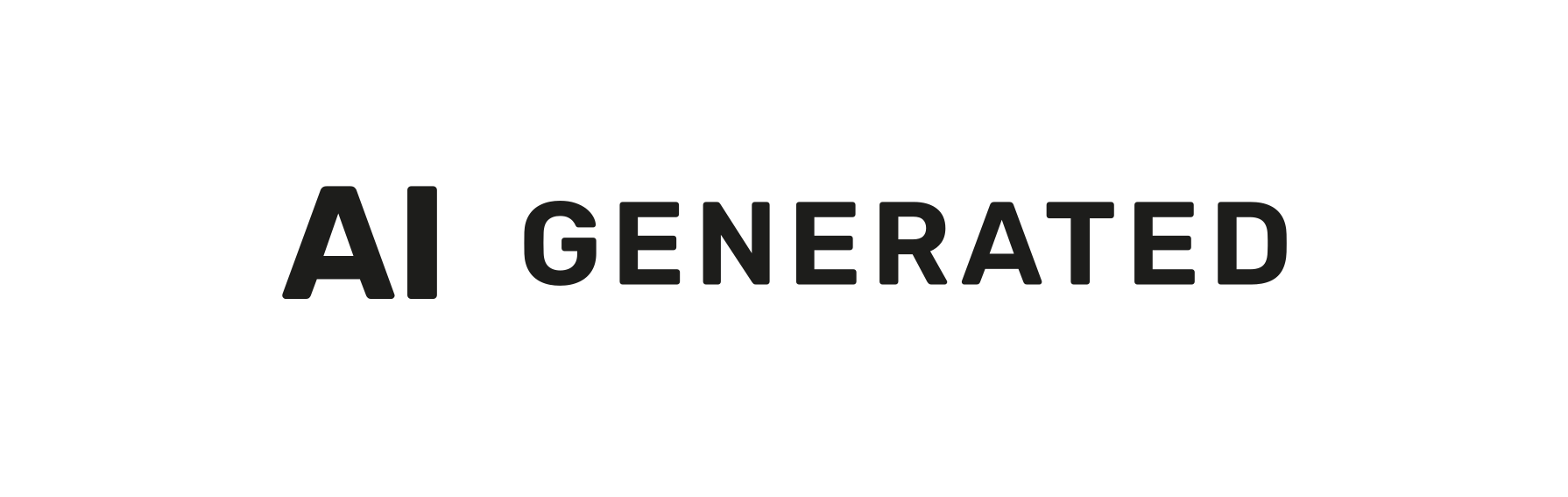
AI GENERATEDFully AI-generated
For a picture made entirely by AI, with no human-made part other than the prompt.
Example: a photorealistic image of a politician at an event that never happened.

AI MODIFIEDPartially AI-modified
For a real, human-made picture partly changed with AI.
Example: a photo of an empty flat, furnished with AI.

AIBasic icon
When AI was involved, paired with your own words (“face generated with”) or an extra layer that tells more.
Example: “Background generated with” followed by the icon.
The Code of Practice adds detail for its signatories: the EU icon or an equivalent label, placed where no other overlay intervenes, “e.g., in the top right corner of an image or video deep fake”; embedded in the content; visible against any background; resized only in proportion, with “AI” in English. In user testing, versions with a word (“generated”, “modified”) did significantly better. The icons are optional and free, and using them doesn't establish compliance by itself: see EU AI icons.
Our free EU AI image label tool draws the Commission's icon into your images, top right or wherever you drag it, without uploading them. Whether an image needs a label stays your call.
Fines, and who enforces them
Breaching Article 50 can cost up to EUR 15 million or 3% of total worldwide annual turnover, whichever is higher (Article 99(4)); for SMEs, start-ups and small mid-caps, whichever is lower. EU institutions face up to EUR 750,000. Each country sets its penalties, warnings included, and authorities may treat commitments under the Code as a mitigating factor. The often-quoted EUR 35 million or 7% is for prohibited AI practices, not for labelling.
National market surveillance authorities enforce, on their own initiative or after a complaint, which anyone with grounds can file (Article 85). The Commission's list of 7 September 2026 doesn't say which one handles Article 50; for France, Germany, Italy and Spain, it names:
| Country | Authority | Status |
|---|---|---|
| France | DGCCRF | Designation pending final adoption |
| Germany | Bundesnetzagentur | Named by the KI-MIG law, in force since 29 July 2026; still “pending” on the list |
| Italy | Agenzia per la cybersicurezza nazionale (ACN) | Listed; decree 179/2026, in force from 23 October 2026, names AgID and ACN as national AI authorities |
| Spain | AESIA | Designation pending |
The Code of Practice and the Guidelines
Two Commission documents fill in Article 50. Neither is binding.
- The Code of Practice on Transparency of AI-Generated Content (final on 10 June 2026) is voluntary: Section 1 for providers' marking and detection, Section 2 for deployers' labelling, Annex 1 for the icons. The Commission (8 July 2026) and the AI Board (9 July) found it adequate, and about 190 organisations had signed by the end of July. Non-signatories must show compliance another way, for example with a gap analysis against the Code (para 148).
- The Guidelines on Article 50 (approved on 20 July 2026) explain the definitions with examples. Formal adoption follows once all language versions exist; in mid-October 2026, only the English version was listed.
Official texts on EU AI labelling
In English, on the EU's own websites. Only the texts in the Official Journal are authentic.
Official texts
 AI Act, Regulation (EU) 2024/1689 (EUR-Lex)Official Journal, 12 July 2024
- AI Act, consolidated version of 27 July 2026 (EUR-Lex)With the Digital Omnibus changes
- Digital Omnibus on AI, Regulation (EU) 2026/1744 (EUR-Lex)In force since 27 July 2026
- Article 50 on the AI Act Service Desk
- Guidelines on the transparency obligations under Article 50
- Guidelines on Article 50 (PDF)51 pages, 20 July 2026
- Q&A: transparency obligations under Article 50
- Code of Practice on Transparency of AI-Generated Content
- EU icons for labelling AI-generated contentSVG and PNG files
- Market surveillance authorities under the AI Act